Essential Oil: One Bottle, Multiple Regulatory Statuses
This article examines the regulatory framework governing essential oils (EOs) in France, highlighting a frequently overlooked point: their legal status depends exclusively on the intended use declared by the market operator. Through a comparative table, concrete examples, and analysis of ANSES data, it outlines potential deviations (inappropriate use declarations, incomplete labelling) and their consequences for consumer safety. Essential reading to understand issues of transparency, traceability, and responsibility in the essential oil sector.
Esméralda Cicchetti
6/5/20253 min read


This article examines the regulatory framework governing essential oils (EOs) in France, highlighting a frequently overlooked point: their legal status depends exclusively on the intended use declared by the market operator. Through a comparative table, concrete examples, and analysis of ANSES data, it outlines potential deviations (inappropriate use declarations, incomplete labelling) and their consequences for consumer safety. Essential reading to understand issues of transparency, traceability, and responsibility in the essential oil sector.
Essential oil: one product, multiple regulatory frameworks
In France, an essential oil does not have a single regulatory status. It may be classified as a food flavouring, dietary supplement, cosmetic ingredient, fragrance component, medicinal product, or even a regulated chemical product. This status depends strictly on the intended use declared by the placing on the market operator and determines all legal obligations: controls, labelling requirements, and consumer safety rules.
In practice, however, this distinction is often blurred — and sometimes deliberately maintained. Analysis follows.
One essential oil, multiple regulatory obligations
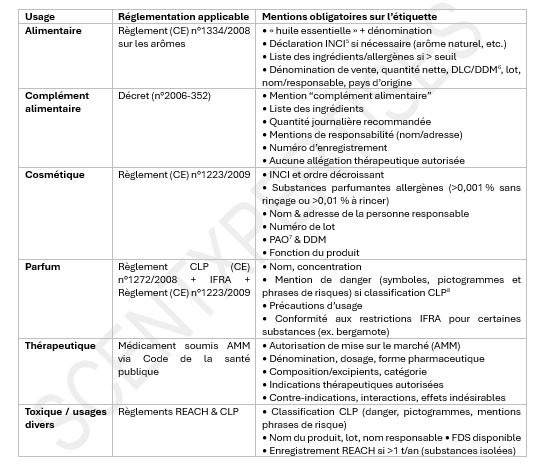
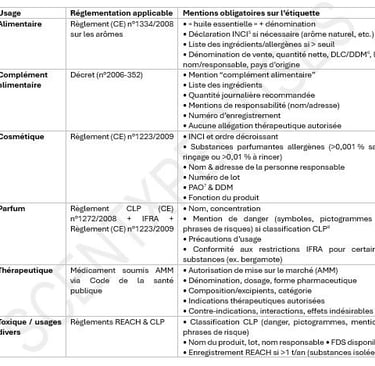
Below is an illustrative overview of labelling requirements applicable to the same essential oil depending on its declared use:
[1] International Nomenclature of Cosmetic Ingredients (INCI)
[2] DLC = Use-by date, DDM = Minimum durability date
[3] PAO = Period After Opening
[4] CLP = Classification, Labelling and Packaging
A major source of consumer confusion
In pharmacies, shops, or online platforms, consumers are often unaware of this diversity of regulatory statuses. They may purchase an essential oil intended for food use (therefore subject to less stringent control regarding cosmetic allergens or hazardous substances) and use it for massage, diffusion, or even therapeutic ingestion — without being informed of regulatory differences.
Why is “food use” declared? A strategic choice
Declaring an essential oil as a food flavouring allows operators to avoid:
mandatory declaration of regulated cosmetic allergens,
obligations under the CLP regulation (hazard pictograms, risk statements, etc.),
IFRA compliance assessments.
This choice is primarily economic: it reduces analytical costs and avoids tests that may be incompatible with small-scale or artisanal production.
However, it is not neutral in terms of consumer safety. For identical chemical compositions, simplified labelling may conceal real risks — particularly in cases of dermal exposure, prolonged inhalation, or inappropriate ingestion.
Contrasting labelling: same lavender, two regulatory realities
Under CLP regulation (cosmetic or fragrance use), lavender essential oil labelling includes:
hazard statements (e.g., “May cause an allergic skin reaction”),
regulatory pictograms,
precautionary statements.
The same batch, when marketed as a flavouring, will not display these elements.
Health consequences: avoidable poisonings
In 2024, ANSES highlighted concerning data: between 2011 and 2021, 45 to 95% of essential oil-related poisonings reported to poison control centres resulted from misuse or misperception of risk. In other words, a lack of clear product information.
Conclusion: an urgent need for transparency
European regulation is clear: it is the operator’s responsibility to define the intended use of the product and comply with the corresponding obligations.
However, the diversity of possible regulatory statuses, combined with commercial ambiguity, contributes to widespread confusion between food, cosmetic, therapeutic, and technical products.
A public debate on essential oil labelling is necessary, along with the development of harmonised labelling based on actual composition rather than declared use alone.
For analytical support related to essential oils, contact us.
References
Expert consensus for healthcare professionals and decision-makers in clinical and medico-social settings. Scientific aromatherapy: recommendations for clinical practice, teaching, and research. 2018.
Paitraud, David. “Golden rules of aromatherapy in pharmacy practice.” Le Quotidien du Pharmacien. 2017.
Faucon, Michel. Scientific and Medical Treatise on Aromatherapy – Essential Oils. 3rd ed. Paris: Sang de la Terre, 2019.
Baudoux D., Blanchard J.M., Malotaux A.F. Practical Notebooks of Aromatherapy According to the French School, Vol. 4 – Palliative Care. 2010.
Franchomme P., Jollois R., Pénoël D. Aromatherapy Precisely. 2001.
IFRA. Analytical method to quantify 57 suspected allergens by GC-MS. 2016.
ANSES. Essential oils: use with caution. Vigil’Anses Bulletin, 2024.